A site your customers can ask, and their AI agents can use
An agentic site answers the customer who asks, works for the AI agent they send, and changes when you ask.
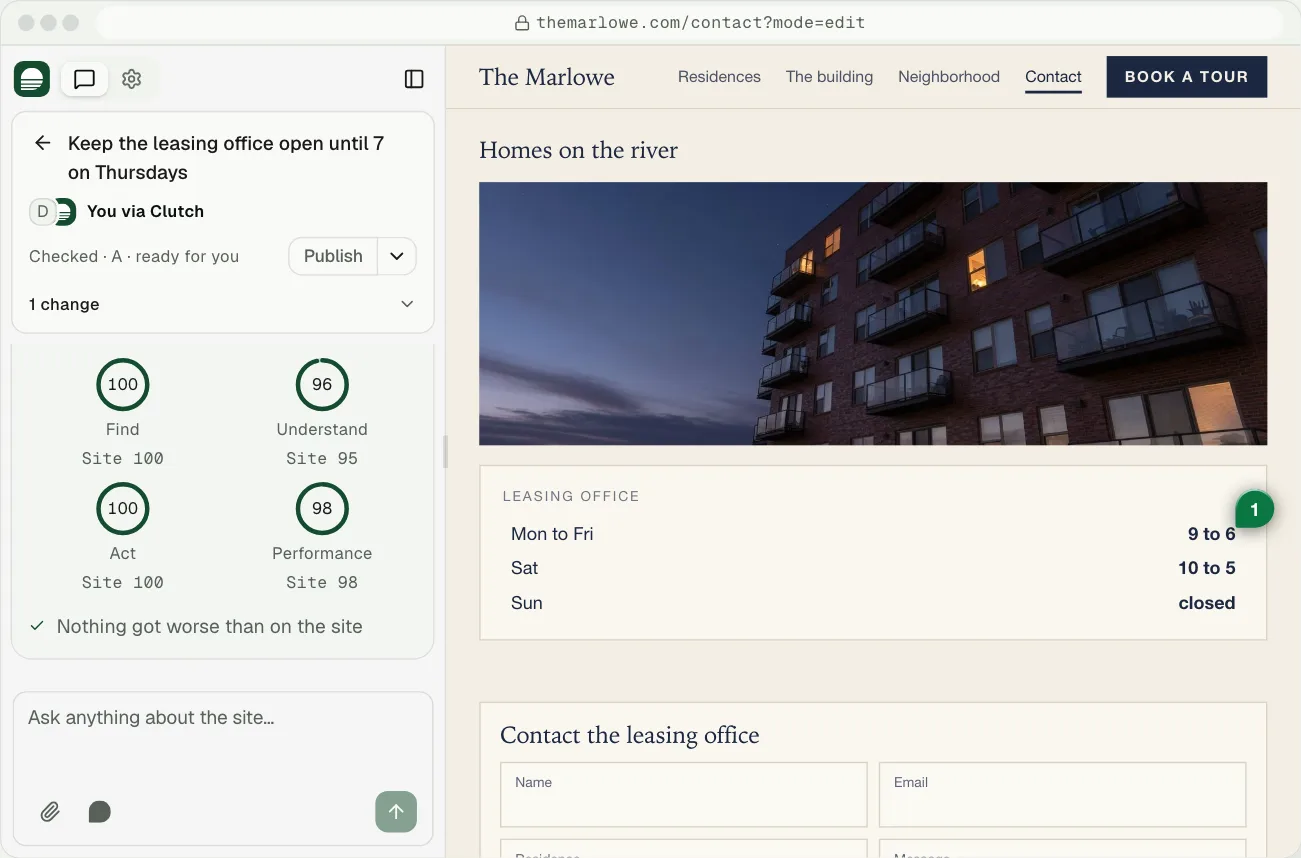
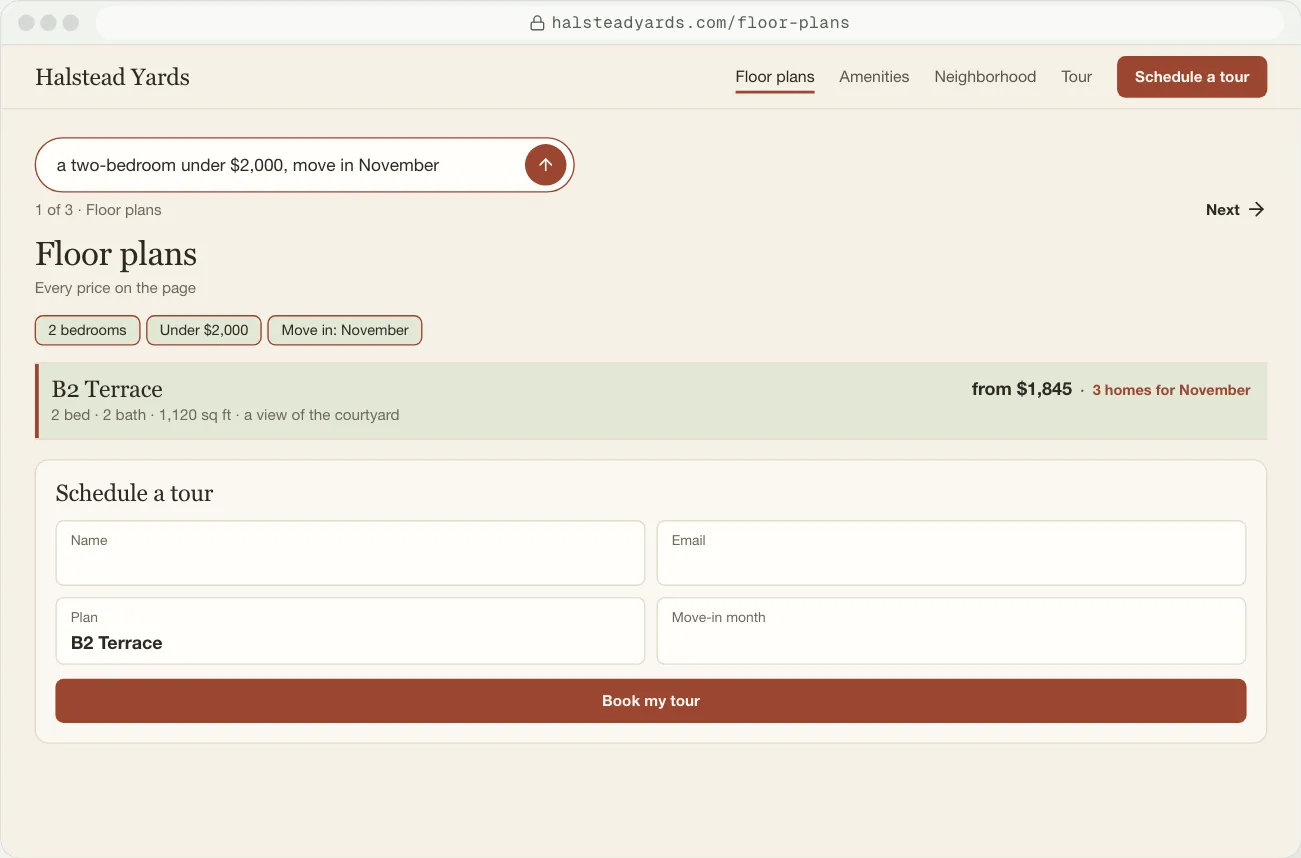
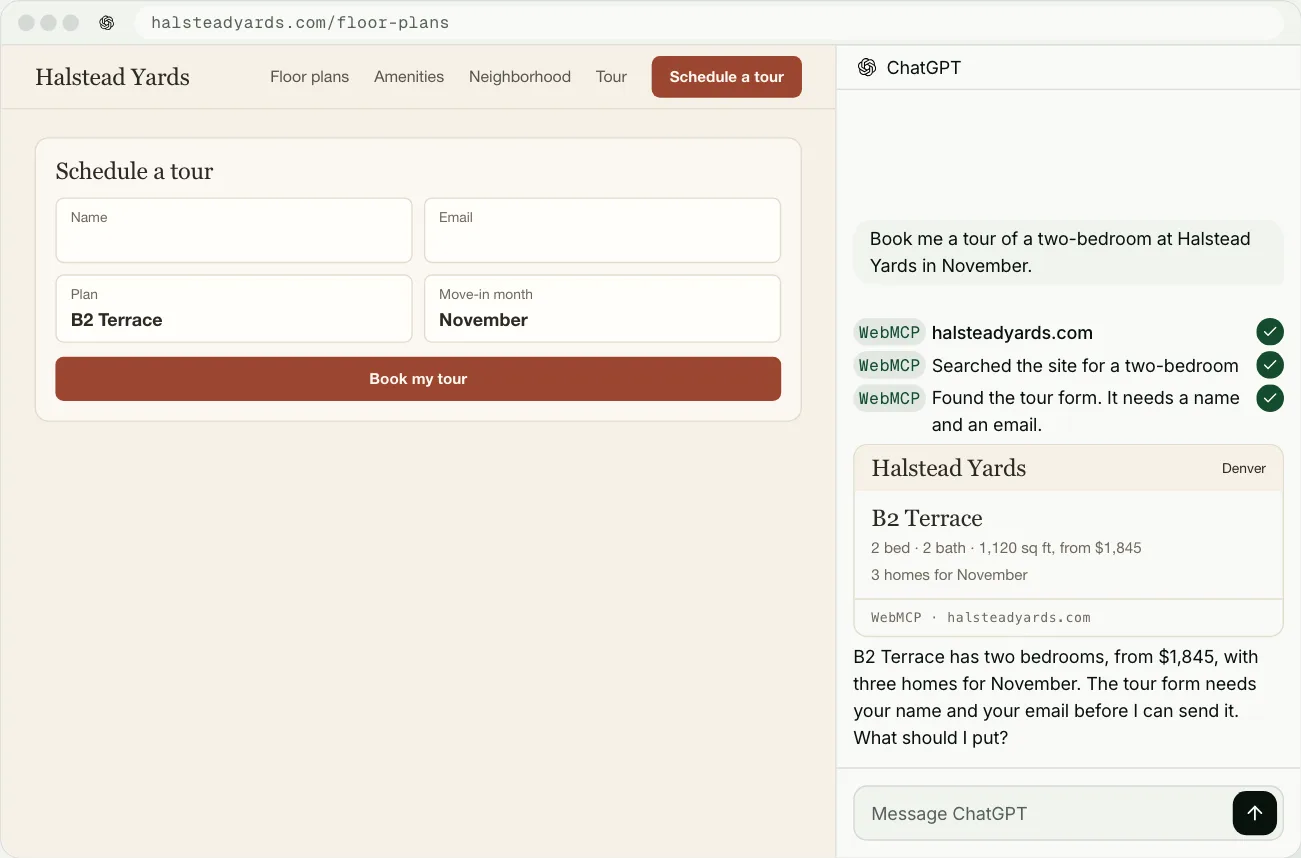
Three parties served by one site, played one after another. Your customer asks, and the site opens the answer. On halsteadyards.com a visitor types “a two-bedroom under $2,000, move in November” into the site's ask box. The site opens Floor plans with 2 bedrooms, Under $2,000, Move in: November set, lists only B2 Terrace, from $1,845 with three homes for November, lights it, and shows the tour form under it. The ask box reads 1 of 3 · Floor plans. Their AI agent acts, booking the tour or placing the order. In ChatGPT's desktop app browser, a person asks: Book me a tour of a two-bedroom at Halstead Yards in November. ChatGPT searches halsteadyards.com with search_site and finds B2 Terrace, from $1,845 with three homes for November, then finds the tour form (request_tour) and fills the plan and the month. The form requires a name and an email, so nothing is sent, and ChatGPT says: B2 Terrace has two bedrooms, from $1,845, with three homes for November. The tour form needs your name and your email before I can send it. What should I put? You change it by asking, and approve the draft. In Clutch's editor on The Marlowe's contact page, the conversation “Keep the leasing office open until 7 on Thursdays” is checked, graded A and ready for you, with Publish beside it.
- 01
Your customer asks, and the site opens the answer.
Read more: Your customer asks, and the site opens the answer. - 02
Their AI agent acts, booking the tour or placing the order.
Read more: Their AI agent acts, booking the tour or placing the order. - 03
You change it by asking, and approve the draft.
Read more: You change it by asking, and approve the draft.
One site that serves three parties
A site shows pages to people who click. An agentic site also does what people ask. It serves your customer, the AI agent your customer sends, and you, the marketer who runs it.
Searches that end in a click on a link
8%
Pew Research Center, 2025-07-22
When Google shows an AI summary, people click a link 8% of the time, against 15% without one.
People are asking AI instead of clicking.
The questions did not stop. More of them go to an AI agent, and an AI agent needs a site it can read and useA site and an agentic site
The same three jobs, done by each.
AskingA customer wants a two-bedroom with a view, moving in November.A customer sends ChatGPT to book a tour for Saturday.You want the leasing office open until 7 on Thursdays.
A customer wants a two-bedroom with a view, moving in November.
A site
A chat box writes an answer. The customer still has to find the page.
An agentic site
Floor plans opens with the November home lit and the tour form under it.
BookingA customer wants a two-bedroom with a view, moving in November.A customer sends ChatGPT to book a tour for Saturday.You want the leasing office open until 7 on Thursdays.
A customer sends ChatGPT to book a tour for Saturday.
A site
The AI agent reads a page laid out for eyes. The form is not a tool it can use.
An agentic site
The site's tour form is a tool. The AI agent fills it, and the site sends it when every required field is there.
ChangingA customer wants a two-bedroom with a view, moving in November.A customer sends ChatGPT to book a tour for Saturday.You want the leasing office open until 7 on Thursdays.
You want the leasing office open until 7 on Thursdays.
A site
You open a ticket and wait. One vendor publishes 14 business days for a portfolio-wide change.
An agentic site
You write one sentence. Clutch changes every place it appears, and you approve the draft.
Your customers ask the site,
and it takes them thereThe concierge opens the page with the answer, sets the filters and lights the line. It answers only from what is on your site.
Every question shows up in your analytics, including the ones the site could not answer.
Ask, and it does the clicking
- Ask for a two-bedroom under $2,000, and it sets the filters.
- Ask for catering for 20 with two vegetarians, and it builds the cart.
- Ask about something the site does not say, and it says so plainly.
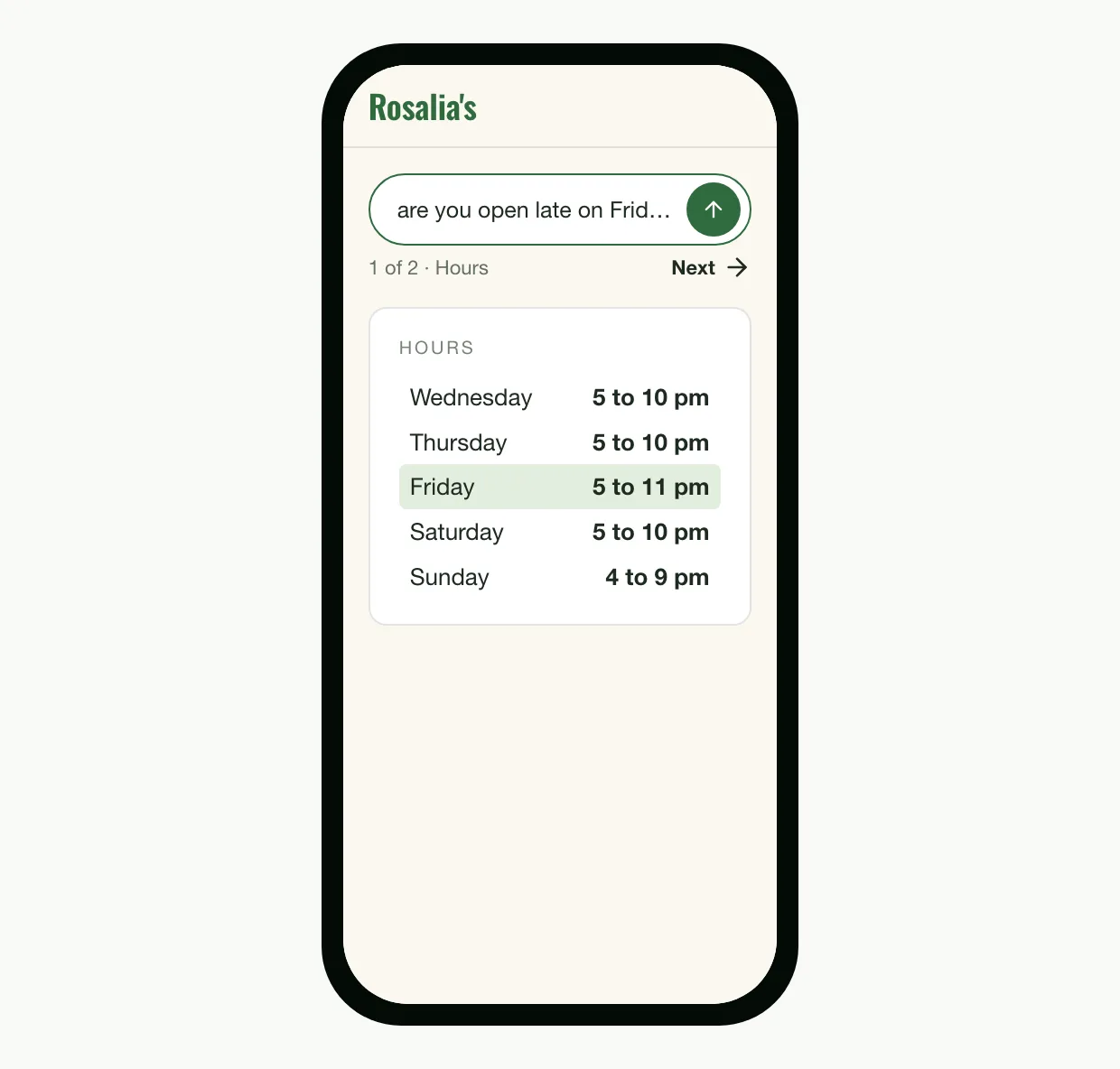
On a phone, a guest asks Rosalia's “are you open late on Fridays”; the same pane rewrites to the hours with the question at the top, and Friday, 5 to 11 pm, is highlighted.
The AI agent they send
can use your siteChatGPT, Grok, Gemini and Claude can find your site and read it. An agent that uses tools can book the tour or place the order.
Chrome is testing WebMCP, an emerging browser standard, and its own example is an apartment search.
What every site carries
- Facts in the page. Each page states its facts in the HTML and in structured data.
- Forms become tools, over MCP and WebMCP. A tool stops and names any missing field.
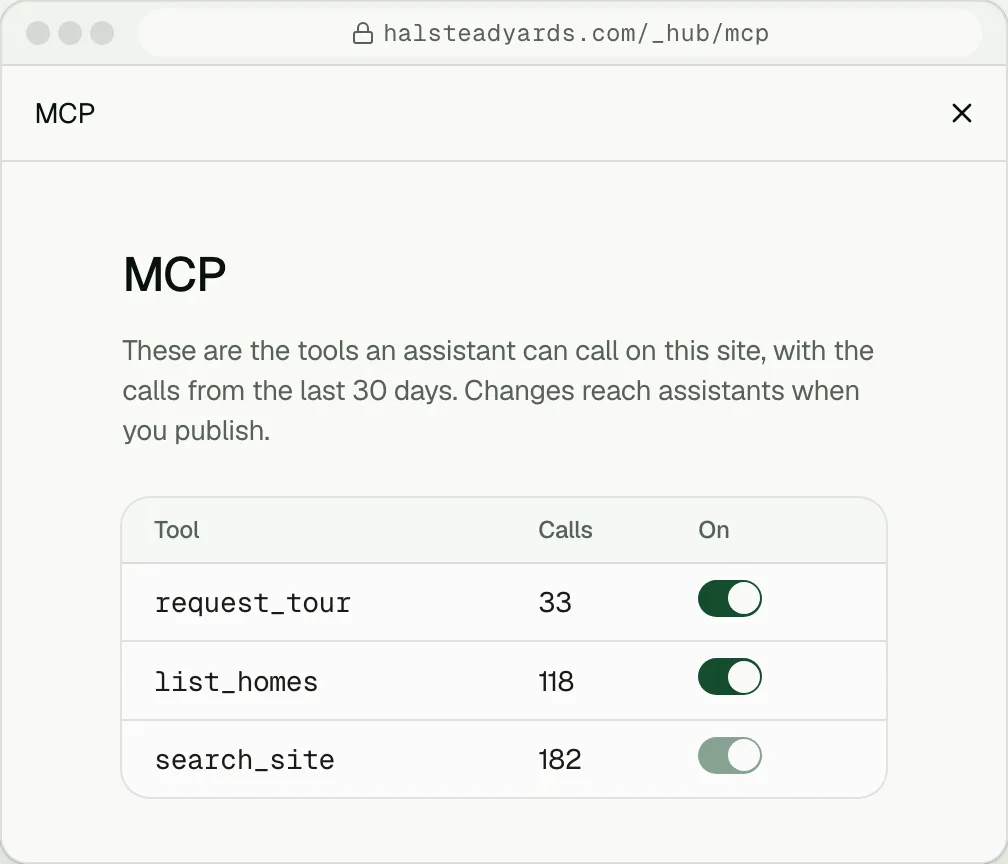
- You choose what AI agents can do. Switch any tool on or off, and see how often it is called.
Change your site by asking
Text it, email it, message it in Slack, or drop a pin on the page. Clutch drafts the change everywhere it appears, and you approve it.
How it changes
- Ask from anywhere: text, email, Slack, Teams, voice, the Clutch app, or your own AI agent over MCP.
- Graded before it goes live. Clutch won't publish a site below an A.
- Nothing goes live until you approve it. Every edit is saved as a version, and any change can be rolled back.